To prosper through the disruption of AI, agencies must get serious about demonstrating the value they bring to client businesses.

To prosper through the disruption of AI, agencies must get serious about demonstrating the value they bring to client businesses.
(This article was originally published by the IPA)
The 2026 IPA Business Growth Conference was hosted by the Chair of the IPA’s Commercial Leadership Group, Publicis Media’s Marcos Angelides. Setting the scene, he promised positivity and substance – “not just inspirational, but also actionable”, the antidote to our industry’s love of an “existential crisis”. All-in-all, a delightfully comforting welcome.
A Business Growth Conference tradition, the first speaker was a very smart economics expert, in this case, Ben Chu. He offered a fascinating, albeit overwhelming deluge of charts illustrating the unpredictability of the world. At this point, Marcos' promise of avoiding existential angst was looking shaky. Happily, writing as a representative of an industry of optimists, despite Ben himself admitting to “flip-flopping daily” on optimism, I chose to believe.
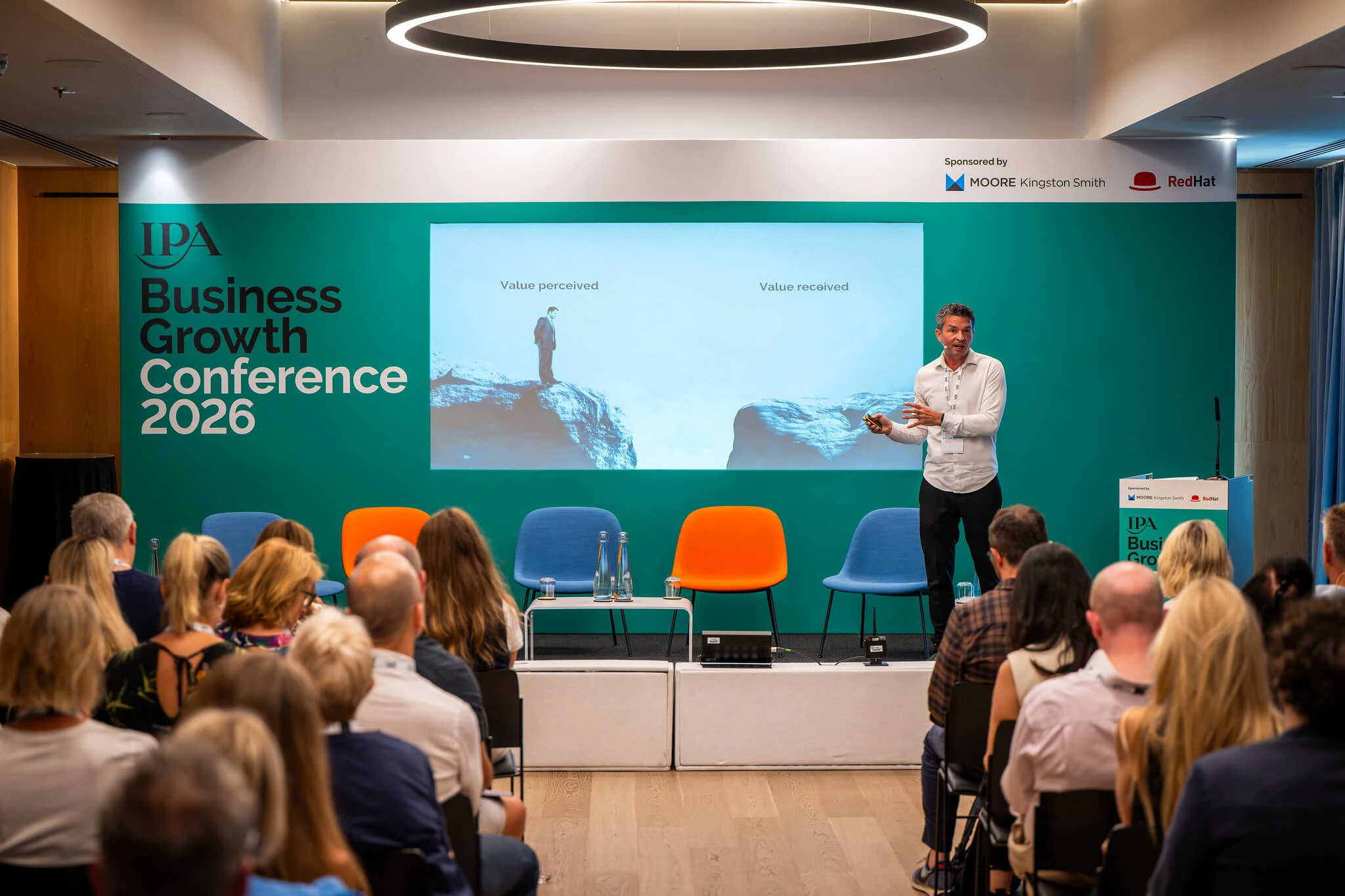
Next up was the IPA's Director of Agency Value, Ed Palmer, presenting findings from ‘Bridging the Gap’, the IPA's new client research project conducted with TrackSuit. The sobering headline was that despite clients valuing agencies, there's a significant gap between the value clients want and the value they perceive.
The data also highlighted a confronting reality on what clients actually value. Top spot went to high-quality asset production, whereas core creative ideas languished in joint tenth (yes, tenth).
These deficits aren’t helping anyone. So while the research did also recognise that clients are increasingly open to embracing new commercial models, clearly agencies need to do more to close this ‘value gap’.
Ed described this as a “B2B marketing challenge”. He’s right – but only up to a point. While perception shift is the goal, the mechanism isn’t better agency marketing – it’s delivering clearer value. And that’s a business strategy challenge, not a campaign brief.
Hot on the heels of Ed’s talk was the first panel of the day. Hosted by Alessandra Bellini OBE, it sought to define agency value. Alessandra cut straight to the chase: clients overwhelmingly say they value agencies, but their day-to-day behaviour (in-housing, remuneration pressure, focus on execution) suggests this value perception isn’t translating into commercial relationships and pricing. So why not?
In response, David Wheldon OBE echoed Ed’s point – agencies need a better narrative, doubling down on enduring and valuable brand platforms rather than selling creative ideas.
VCCP’s Andrew Peake agreed – brand platforms are “the glue that creates the value”, binding together thousands of assets and delivering long-term growth. He argued that agencies should start every engagement with the client's commercial objectives, then show how strategy, creativity and execution all ladder up to business value.
IPA President and BBH CEO Karen Martin was also on the same page, recommending that agencies avoid being seen as just ‘suppliers’: "We can't answer your brief until we understand what big commercial goals we have.”
Former Virgin marketer Annabelle Cordelli said it best: “Work out what the agency is absolutely brilliant at and double down on that.” She added that this is where confidence in pricing begins. Wise words.
Next on stage was The Gate’s CEO, Helen James, overseeing a mock trial of competing visions for the agency of the future. The twist? The jury was AI-generated. Just for funsies.
WPP’s evidently well-read Daniel Hulme cited citadels and renaissances, as well as the ancient Greeks' three pillars of persuasion, arguing that in a chaotic world, marginal gains in both judgement and technology will give agencies an edge.
Wonderhood CEO Alex Best doubled-down on judgement as AI democratises capability – “When everyone can make anything, the most valuable company is the one that knows what's worth making.”
With a double dose of nominative determinism, the victor was AAR’s Victoria Fox. Her cunningly powerful slogan was that clients “come for the leap”. While this (synthetic and human) crowd-pleaser neatly made the case for judgement, it was an awkward reminder that most agencies still charge for execution.
The IPA’s Paul Bainsfair then interviewed WPP CFO Joanne Wilson. Formerly a client-side finance leader, she calmly reinforced the commercial realities of the day. First, AI renders the FTE model unfit-for-purpose. And most starkly on the value gap: "Only 27% of agencies feel they get fair value for the work they do – whereas every client thinks they're overpaying for our services."
As Paul rightly implored, agencies must remind Procurement that our work “is not a commodity”. But the implicit admission is that agencies know that’s how they’re perceived.
The day’s final panel picked up the ‘judgement’ baton to explore why cash-strapped agencies must still prioritise the next generation of talent. In short, because if we don’t, we don’t have an industry.
Chaired with passion by Craft Media’s Yewande Ogunkoya, we heard a two-part counter argument to the common concern that AI removes the need to hire junior people.
First Publicis’ Paola De Marchi made the case for value: “Early careers bring such a fresh perspective – they're native to the tech we use”. Then Yewande raised – literally – the money question: the ROI of early-career talent. As Born Social’s Kate Higham put it, agencies must “think about how early careers talent get billable and productive faster”.
And on the subject of affordability, McCann’s Ollie Purdom pointed at the lunacy (my words, not his) of “millions of pounds sat in levy funds that we as an industry aren’t utilising”.
Drawing these strands together, Kate rightly challenged the audience: “Get out of that short-termist mindset because it's going to impact the long-term growth of your business, as well as the industry."
And so to the final speaker, Matt Phelan – founder of The Happiness Index. Combining agency insight, dry wit and research-based rigour, Matt offered the perfect bookend to the day: "Companies with happier employees are more creative, more productive and make more money."
Clearly an easy sentiment to cheer. But taking his own advice that ideology alone doesn’t drive impact, Matt also offered a range of leadership tips – from creating safety and offering acknowledgement, to the disproportionate impact of giving people role clarity. All of which sound rudimentary, but across our mad-busy and commoditised industry, are often in short supply.
From the chaotic economic context and an evidence-based reality check, to a chorus of support for ‘judgement’ and the importance of nurturing the humans that provide it, this was a beautifully crafted agenda. And to Marcos’ initial promise, the day did indeed offer practical guidance alongside inspiration.
That said, we didn’t go far enough. Reviewing last year’s conference summary, the progress on the AI debate and its impact on agency value is commendable. Kudos to the IPA for that. But our industry still needs to evolve faster.
My takeout from last year was that agencies need to be seen differently in order to price differently – not the other way round. You won’t solve commoditisation by upgrading your pricing models. Our work at Co:definery consistently shows that agencies only command a premium once you offer something tangibly different to your competitors.
In codifying the ‘value gap’ the IPA has now provided valuable language and robust data to support what agency leaders already knew – you must focus on client business outcomes.
So therein lies Ed Palmer’s “B2B marketing challenge”. As agencies unite to anoint ‘judgement’ as your defence against the playing field leveller that is AI, all you’re doing is rebranding ‘creativity’ as your collective differentiator. This is a grave mistake. First, a ‘collective’ differentiator is a contradiction in terms. More importantly, clients aren’t buying ‘judgement’ – that’s just another input – they need you to empty their shelves.
Ironically, it was a client who best articulated the alternative – Annabelle Cordelli said: “value is what agencies need to know and own – turning it into a clear proposition. Everyone doesn't need to be brilliant at everything... get really tight on the superpowers of your agency."
Put another way, don’t trade on table-stakes human ingenuity – instead focus on how you apply it to deliver commercial impact for only those clients you’re best suited to help.
Warren Buffet said: “Only when the tide goes out do you discover who's been swimming naked”. AI didn’t cause agency commoditisation, it’s just accelerated the endgame. Selling ‘creativity’ (or ‘judgement’) and being all-things-to-all-people is no longer a viable business strategy.
Thanks to the IPA, you now have the facts. This isn’t existential angst, it’s existential awareness. And the time for action is now. As Matt Phelan cautioned, once the evidence is clear, ignorance is no longer a defence – after that, failure to adapt is incompetence.